
Lyon County Projected vs Actual Release
A projected or anticipated date is a calculation, not proof that a Lyon County person walked out. For a sentenced state prisoner, it reflects the sentence data and rules MNDOC has applied at that point. The physical release can still be affected by discipline, a court change, a consecutive sentence, another jurisdiction's hold, or administrative processing. The actual release record answers a different question: when did this custody episode end, under what authority, and did the person enter the community or go to another custodian?
A pretrial detainee usually has no fixed sentence-completion date. Bond, dismissal, personal-recognizance release, and other court orders can end local custody. A hold can prevent a community release even after one Lyon County charge is resolved. For a person serving a local jail sentence, the current roster may show Sentence Date and “Actual Completion Date,” but that completion field can be future-facing. It must not be silently treated as an observed past exit.
Note: Absence from the Lyon County roster may mean release, transfer, or another custody handoff, so confirm the disposition.
Find a Lyon County Projected Release Date
Choose the route from the custody episode. The Minnesota Department of Corrections Public Viewer covers adults committed to the Commissioner who remain under MNDOC jurisdiction. It can include incarcerated people and people already in the community under supervised release. It does not cover every Lyon jail-only sentence, and it is not a permanent archive after final discharge. A local sentence instead requires the jail record and court order.
- Classify the custody. Decide whether the person is a Lyon County pretrial detainee, a locally sentenced jail inmate, or a prisoner committed to MNDOC.
- Use the court file. Find the Lyon County court number through the local District Court route and read the sentencing order for the executed term, jail credit, stayed portions, and later amendments.
- Search MNDOC when applicable. Use the exact MNDOC Offender ID or a name. Confirm the match with birth date, aliases, offense, and court file.
- Read the precise date label. In the Public Viewer, note Current Status, Anticipated Release Date, Expiration Date, and caseworker. In a certified summary, keep projected and eligibility fields separate.
- Verify a local date. Call Lyon Jail Reception or Records at 507-929-6623 and ask for the scheduled and actual release details. Contact Records at 507-929-6621 for a documented request.
- Check for a hold or transfer. The court order may authorize release while another agency still has custody authority.
The MNDOC Public Viewer is the official first stop for a state prisoner connected to Lyon County.
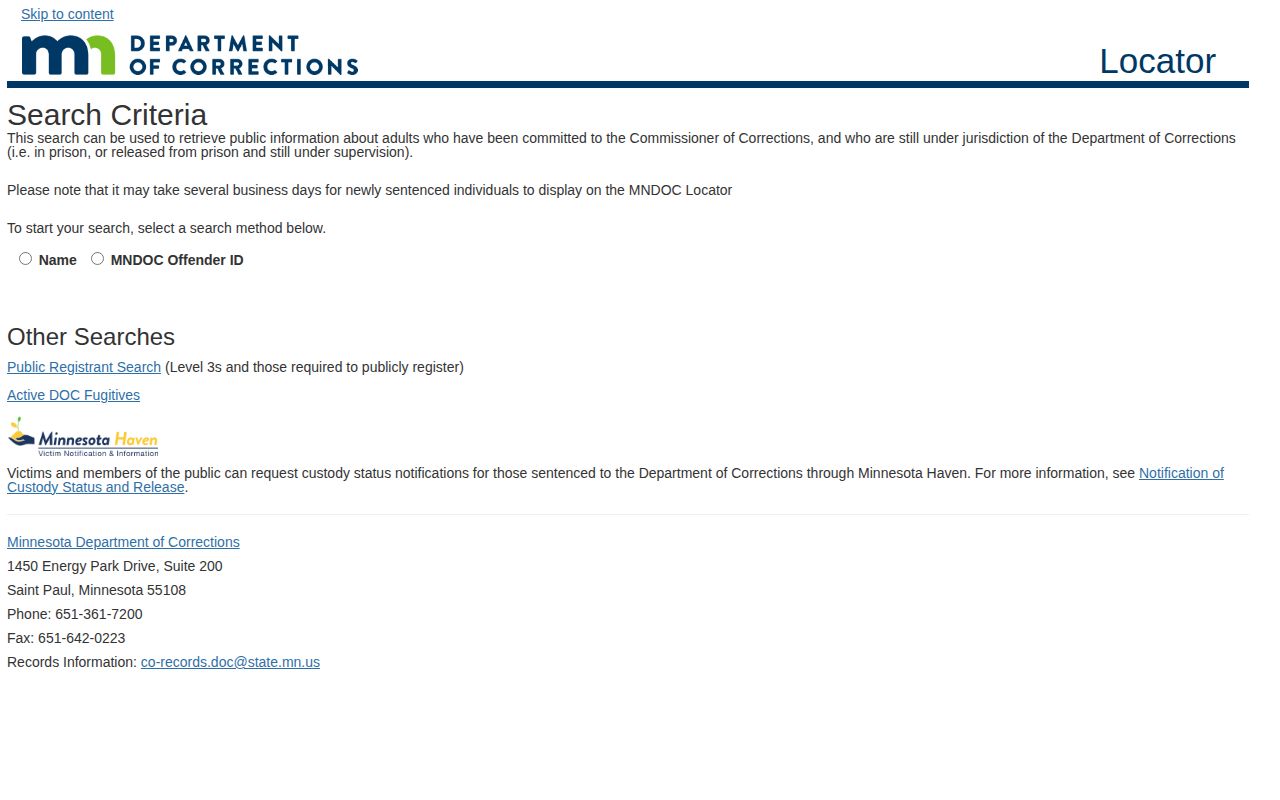
The search screen identifies its public scope. A no-result response can reflect spelling, timing, a local-only sentence, or final discharge, so it does not establish that no prison record existed.
Lyon County Release Date Labels
Minnesota records use several date fields that sound alike but are not interchangeable. The Public Viewer uses the exact label “Anticipated Release Date.” MNDOC's certified case-summary form separately includes “Parole/Supervised Release Eligibility Date” and “Projected Release Date.” Expiration Date concerns the end of the sentence or department jurisdiction, which generally comes later than release from prison. For a board case, eligibility marks the point at which release may be considered under the governing statute. It is not a promise.
| Record label | What it means | What it does not prove |
|---|---|---|
| Anticipated Release Date | The Public Viewer's current forward-looking MNDOC date | The exact door time or final community release |
| Projected Release Date | A calculated field on the certified case-summary form | That no later credit, discipline, or case change will occur |
| Parole/Supervised Release Eligibility Date | A date when the relevant release status may become available | A board grant or a completed release |
| Expiration Date | The end of sentence or MNDOC jurisdiction | The earlier prison-release date |
| Actual Completion Date | A Lyon roster charge or sentence field that may be future-facing | An observed Lyon jail exit timestamp |
The detail-view interface demonstrates these fields in their official context. The MNDOC example interface is useful for labels, not for republishing any example person's facts.
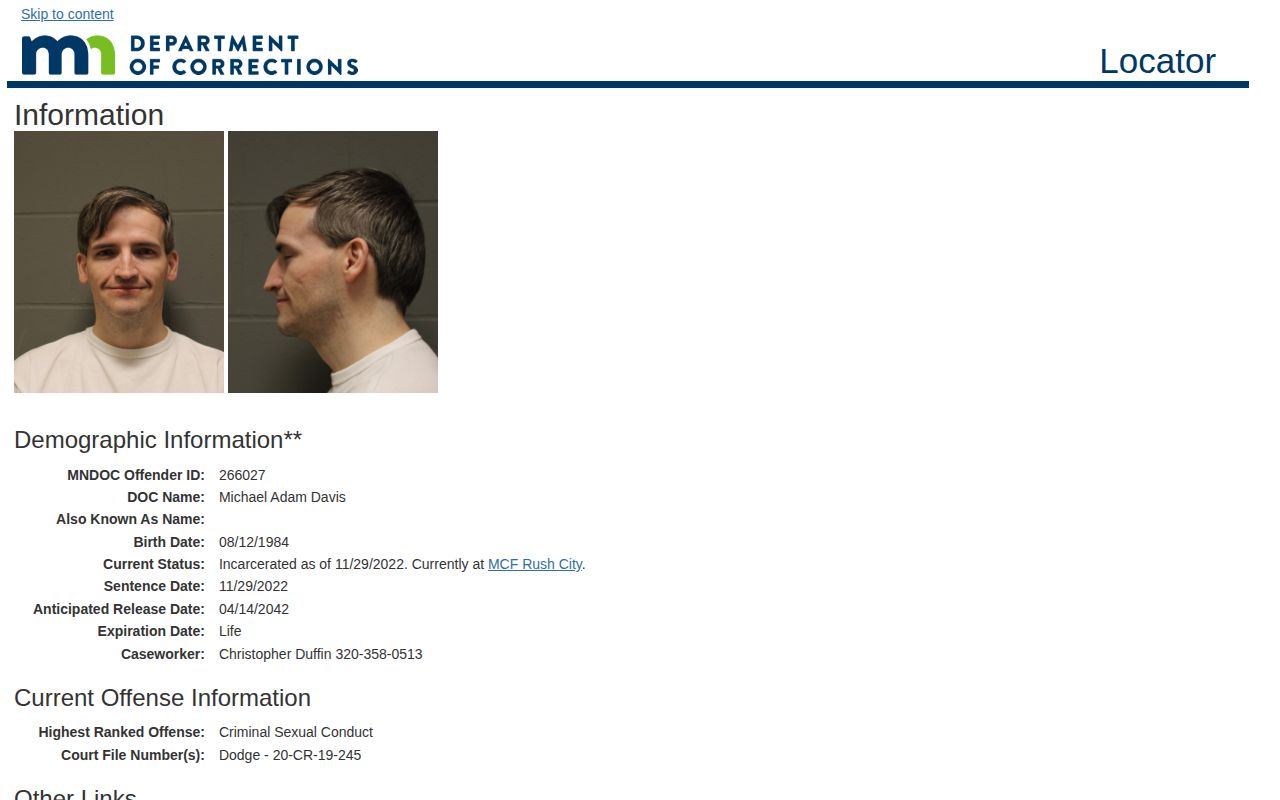
Current Status controls interpretation. If the record still says incarcerated, a date alone should not be rewritten as a completed release.
Note: Eligibility, anticipated release, projected release, actual release, and expiration each answer a different part of the sentence timeline.
Minnesota Release Credits for Lyon Cases
Minnesota does not use a general rule that everyone serves 85 percent. For fixed executed felony sentences tied to offenses on or after August 1, 1993, Minn. Stat. § 244.101 sets the normal structure: two-thirds as the minimum imprisonment term and one-third as the maximum supervised-release term, subject to the supervised-release statute. That final third remains part of the executed sentence. It is served in the community under conditions, not erased.
The Minnesota Rehabilitation and Reinvestment Act creates earned incentive release credit for eligible people who complete objectives in an individualized rehabilitation plan. Section 244.44 puts the credit into the imprisonment calculation. Current law caps credit at 17 percent of the total executed sentence and does not permit imprisonment below one-half of the sentence. The credit does not enlarge the supervised-release term. It may be revoked for a facility-rule violation or criminal act, and MNDOC reports that not everyone qualifies.
Older cases require a different rule. Section 244.04 addresses legacy good time for a defined older offense cohort. It provides one day of reduction for each two discipline-free days under its own limits. Life sentences, specified old indeterminate sentences, MRRA exclusions, and modern fixed sentences cannot be blended into one formula. Date math without the offense date, sentence type, and full MNDOC calculation is unreliable.
| Framework | Who it concerns | Key caution |
|---|---|---|
| Two-thirds / one-third | Ordinary modern fixed executed felony sentences | The community third is still part of the sentence |
| MRRA earned incentive credit | Eligible people with approved plan progress | Caps, exclusions, and possible revocation apply |
| Legacy good time | A defined older offense cohort | It cannot be applied to every Lyon County sentence |
| Board eligibility | Limited life, old indeterminate, and specified cases | Eligibility does not equal a release grant |
Why Lyon County Release Dates Change
A date can move because a sentence is not just calendar subtraction. MNDOC may receive new court documents, apply or revoke eligible credit, add disciplinary confinement, or account for a consecutive case. A hold from another authority may not alter the computed end of one sentence, yet it can alter whether the person enters the community. For local custody, bond and court action can create a release path that no sentence calculator could predict.
| Factor | Effect on the date or exit | Where to verify |
|---|---|---|
| Earned credit | May shorten eligible imprisonment within statutory limits | Current MNDOC record or Central Records |
| Discipline or program refusal | May delay release or affect available credit | MNDOC calculation and current status |
| Consecutive sentence | May keep custody in place after one term or parole event | Sentencing orders and certified summary |
| New court order | May amend, stay, revoke, or otherwise change custody authority | Lyon court Register of Actions and filed order |
| Detainer or warrant | May cause transfer rather than community release | Jail release disposition and receiving agency |
| Administrative processing | Can make the physical exit later than a scheduled time | Facility or jail release record |
Parole-board decisions add another layer for the limited populations within board jurisdiction. The board can set a projected date or continue a case with directives, but it cannot release a person before the statutory minimum. A grant can be rescinded after a prerelease violation. Constructive parole may also end one sentence while a consecutive sentence keeps the person imprisoned.
Note: A changed date is not always an error; it can reflect a new legal event, credit decision, hold, or corrected calculation.
Lyon County Jail Release Timing
The Lyon County Jail publishes no local good-time calculator or formula. Its roster can list sentence and completion fields, but Jail Records and the sentencing order are the sources for the scheduled and actual release. Jail credit should be read from the court record rather than inferred from the booking date. Pretrial custody remains controlled by bond, court orders, dismissals, and holds rather than a computed prison-release date.
The official jail policy says sentenced inmates are processed for release at approximately 8:00 a.m. on the scheduled date and picked up through the front lobby after 8. Processing means the exit may not happen at that exact time. The policy concerns scheduled sentenced releases. It should not be applied to every bond or immediate court-order release.
The official policy page shows the local release-time instruction alongside bail and jail practices.
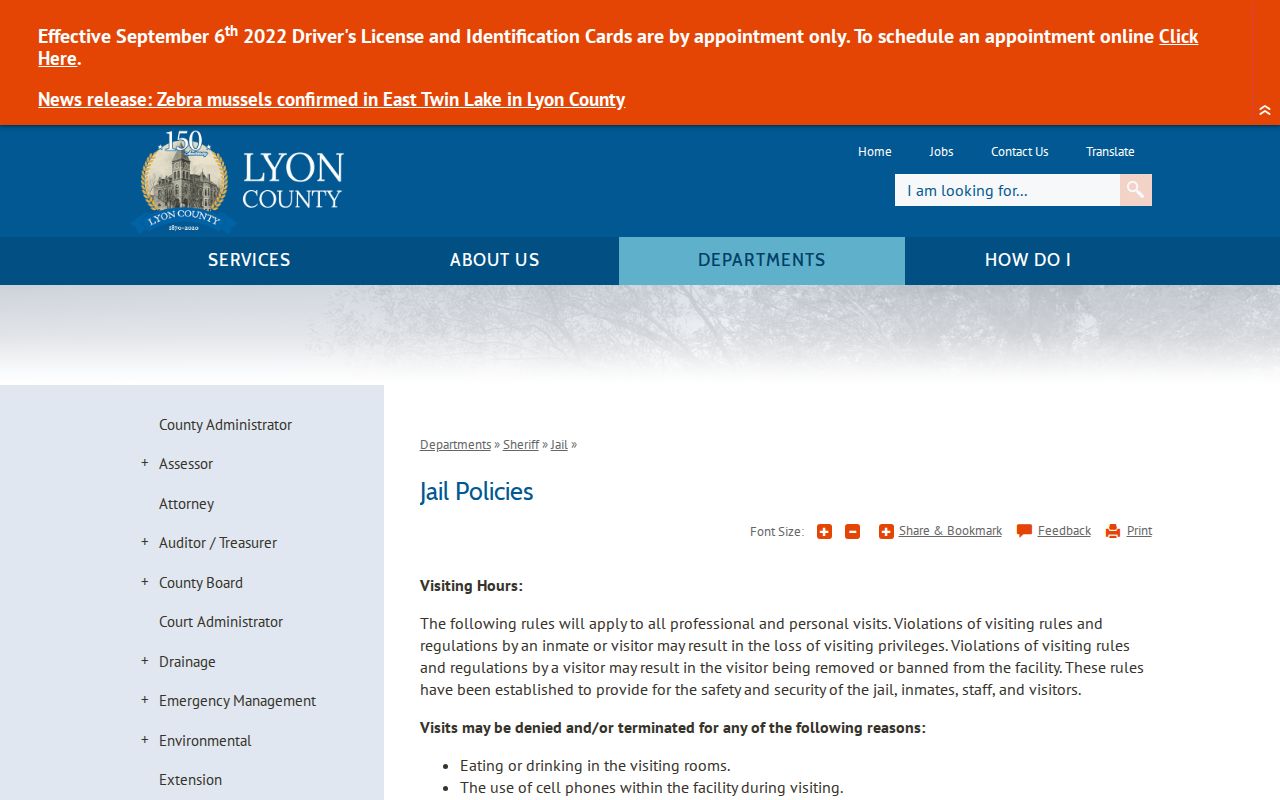
The practical lesson is narrow: use the scheduled date to plan, then confirm processing and the actual release with Lyon Jail Records.
Minnesota Weekend Release Date Rule
Minn. Stat. § 244.05, subdivision 1a contains a precise weekend and holiday shift for the covered MNDOC scheduled-release context. For offenses before August 1, 1992, a Friday, weekend, or legal-holiday date shifts to the last preceding qualifying day. For offenses on or after that date, the scheduled release shifts to the first following day that is not Friday, Saturday, Sunday, or a legal holiday.
This is the distinctive computation point for a Lyon-connected MNDOC case. It does not create a general Lyon County Jail weekend rule. The offense date matters, and so does the custodian applying the statute. A local jail sentence, a bond release, and an MNDOC scheduled release must remain separate. Applying the state-prison shift to a county-jail sentence would invent a local policy the sheriff has not published.
Confirm Lyon County Actual Release
Use the newest agency record on the day release is expected. For a state prisoner, open the Public Viewer detail and read Current Status with the date fields. If the record still says incarcerated, contact the listed facility, caseworker, or MNDOC Central Records at co-records.doc@state.mn.us. For a county-jail sentence, call Jail Records and request the actual release date, time, disposition, and destination if public.
Minnesota VINE can notify users about county-jail events, but it does not replace MNDOC's state-prison notification route. A Lyon VINE event also needs its exact label read: release, bond release, court-order release, transfer, escape, record purge, unsupervised custody, and death are distinct. Instructions for one-person registration are on the Lyon County VINELink Check. For state-prison notices, Minnesota uses Haven through MNDOC Victim Assistance.
When a historical date matters, obtain the actual release transaction. Sheriff Eric Wallen is the responsible authority for requests made through the Lyon County Sheriff data page. The Lyon County released-inmate search and record route explains how the jail record, court file, and state record fit together. A court release order establishes legal authority, while the facility record confirms when processing ended and whether another hold caused a transfer.
Note: Confirm both the end of the named custody episode and the destination before describing a projected date as community release.