
Lyon County Mugshot Records
A booking photograph records a person's appearance during a custodial process. Minnesota law defines it as law-enforcement data. Under Minn. Stat. § 13.82, subdivision 26, the image is public data unless the agency temporarily withholds access because release would adversely affect an active investigation. That rule does not end when the Lyon County custody episode ends.
The photo proves that an image was made during booking. It does not prove guilt, the final charge result, or current custody. A Lyon County Jail image also should not be confused with a later MNDOC correctional photo. Those records may portray the same person at different agencies and times. The source and episode are part of accurate identification.
The official statute page captured in the manifest shows the Minnesota booking-photo rule that controls access.
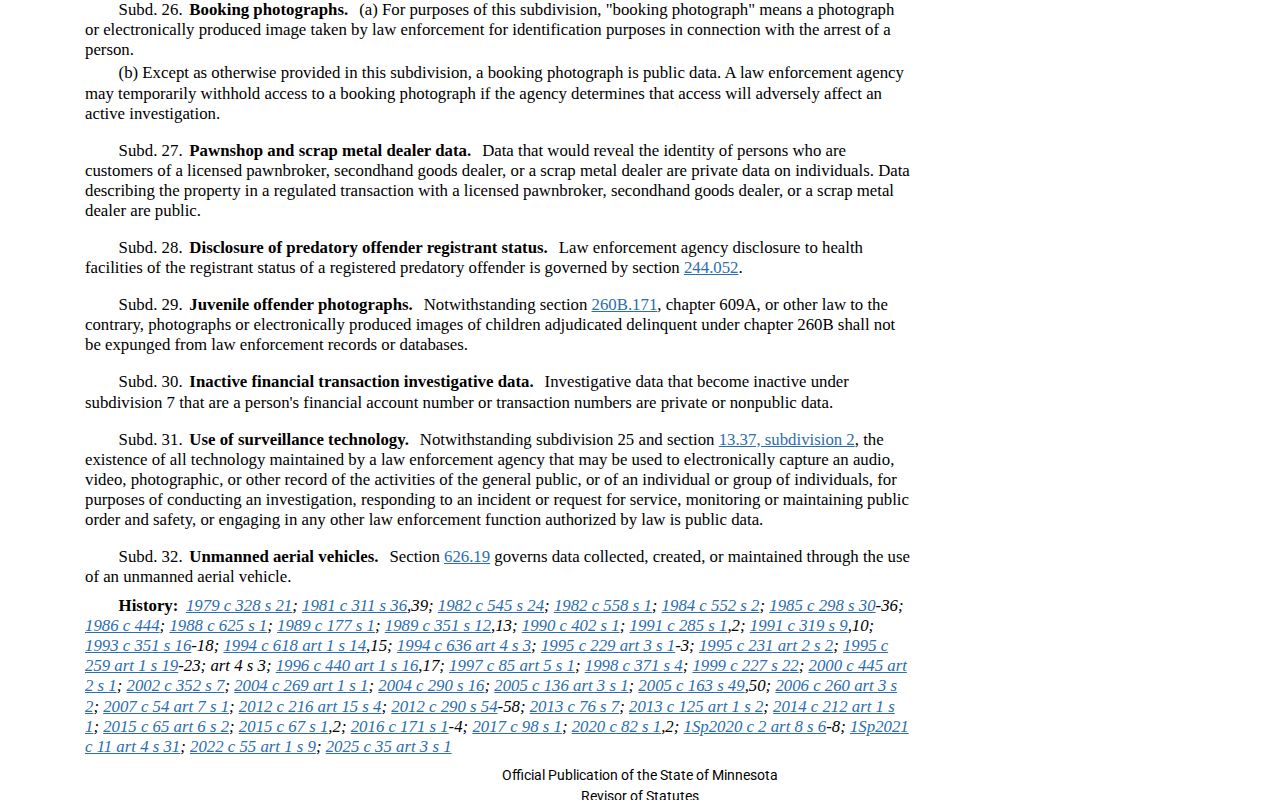
The statutory text supports a request to the creating agency while preserving the active-investigation exception.
Lyon County Mugshot Sources
Each channel has a different scope. The most reliable route starts with the agency that created the image. The table separates a current display from an official retained record and from copies that may circulate elsewhere.
| Channel | Has photo? | How to access |
|---|---|---|
| Lyon County In Custody List | Yes, for current entries | Open the official live roster; it is not a historical gallery. |
| Sheriff mobile app | No official app found | No sheriff App Store or Google Play route should be assumed. |
| Sheriff records request | Yes, subject to law | Identify the person and booking episode and ask for the electronic booking image. |
| MNDOC Public Viewer | May show front and side photos | Use for a person within Minnesota corrections jurisdiction, not for a jail-only case. |
| VINELink | Not promised | Use it for custody events and alerts, not as a photo retrieval source. |
| Outside publishers | May retain copies | Treat an image as unverified and outdated until matched to an official record. |
| News or sheriff posts | Sometimes | A case-specific image is context, not a routine released-person archive. |
No official Lyon County 24-hour or 72-hour released-person feed was found. Therefore no such feed can be used as a historical photo list. The official roster is titled In Custody List and refreshes on the county's stated cycle.
Note: A photo that remains online after release does not establish that the person is still held at Lyon County Jail.
Lyon County Roster Mugshots
The official Lyon County In Custody List embeds booking images for people on its current report. The source images are 160 by 147 pixels. Alongside the photo, the report can show name, booking date and time, arresting agency, charges, a status for each charge, sentence date, and an Actual Completion Date label. Some fields may be blank.
Interpret the page by its title. It is a custody list, not an image archive for Lyon County releases. Once an entry leaves the report, there is no county-published historical gallery to browse. A short booking can also fall between public views. The county says its roster updates every 12 hours, so it should not be treated as a minute-by-minute release record.
The matched roster image comes from the live Lyon County report.
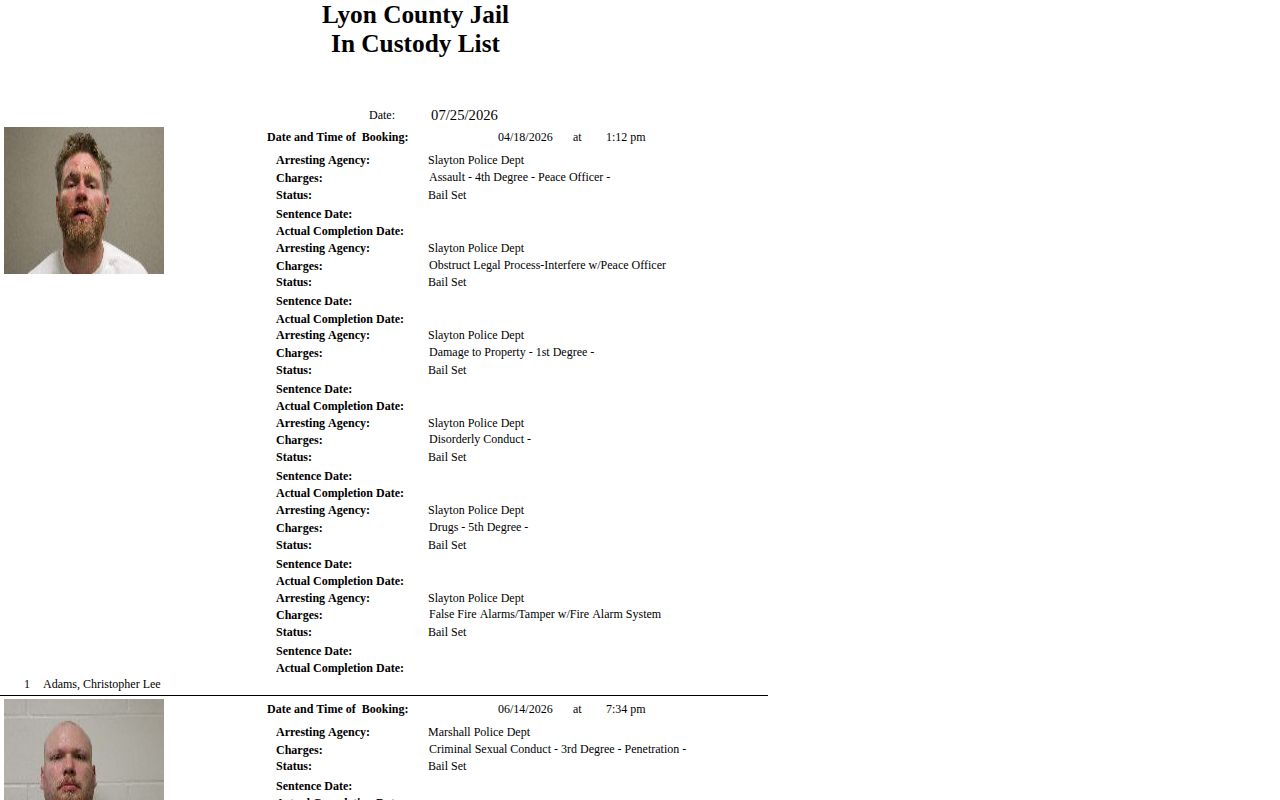
The screenshot illustrates where photos appear for current entries and why the report heading must control its use.
Charge-level status creates another trap. Released Own PR, Chg Dismissed, Time Served, or Book/Release can appear beside one count while another count keeps the person in custody. A roster mugshot and one released charge do not establish that the jail episode ended. Check all counts and the actual release event.
Readers looking for a same-day custody change can follow the Lyon County 24-Hour Release List workflow, which explains why the current roster must be paired with VINE and jail records when no official released feed exists.
Request a Lyon County Mugshot
After a photo drops from the roster, the Sheriff's Records Division is the direct official route. The Lyon County data-request page provides the request form and records contacts. A precise request helps staff locate the right image and distinguish bookings involving similar names.
- Give the full name, known aliases, and birth date if known.
- Identify the booking-date range, arresting agency, booking number, or court file when available.
- Ask for the electronic booking photograph from that specific custody episode.
- State that electronic delivery is preferred and request a cost estimate before chargeable work begins.
- If part of the file is protected, ask the custodian to redact it and provide the separable public data.
The official Sheriff data-request form collects requester contact information, a description of the data, the desired inspection or copy method, and delivery details. Lyon County does not publish a guaranteed number of days for completion. Minnesota's Data Practices Act calls for prompt or reasonable access, with timing affected by scope, retrieval, redaction, and payment.
The county's 2026 schedule lists a printed photograph at $5. A digital booking image may be handled differently. Ask for an electronic estimate rather than assuming the printed-photo amount or promising free delivery. Sheriff Eric Wallen is the responsible authority; Records designee Elizabeth Sieber can be reached at 507-929-6621, and Jail Reception and Records is 507-929-6623.
A broader request can include the booking sheet, admission date and time, actual release date and time, release disposition, and receiving agency if public. That packet links the image to the correct Lyon County event. The Lyon County released-inmate record process explains how roster, VINE, court, and state corrections sources fit together without treating any one source as a permanent archive.
Lyon County State Corrections Photos
A person transferred from Lyon County Jail after an executed prison sentence enters a different records system. The MNDOC Public Viewer can show front and side correctional photographs for adults committed to the commissioner and still within MNDOC jurisdiction. It also displays identifiers and status fields that help match the right person.
These images are not necessarily the Lyon arrest photo. They were made for the state corrections record. Search by exact MNDOC Offender ID when known, or by first and last name. Compare birth date, aliases, offender ID, court file, and offense context before relying on a match. A person who served only a local Lyon jail term may never appear in the viewer.
The official interface example captured in the manifest shows the MNDOC detail-view photo fields.
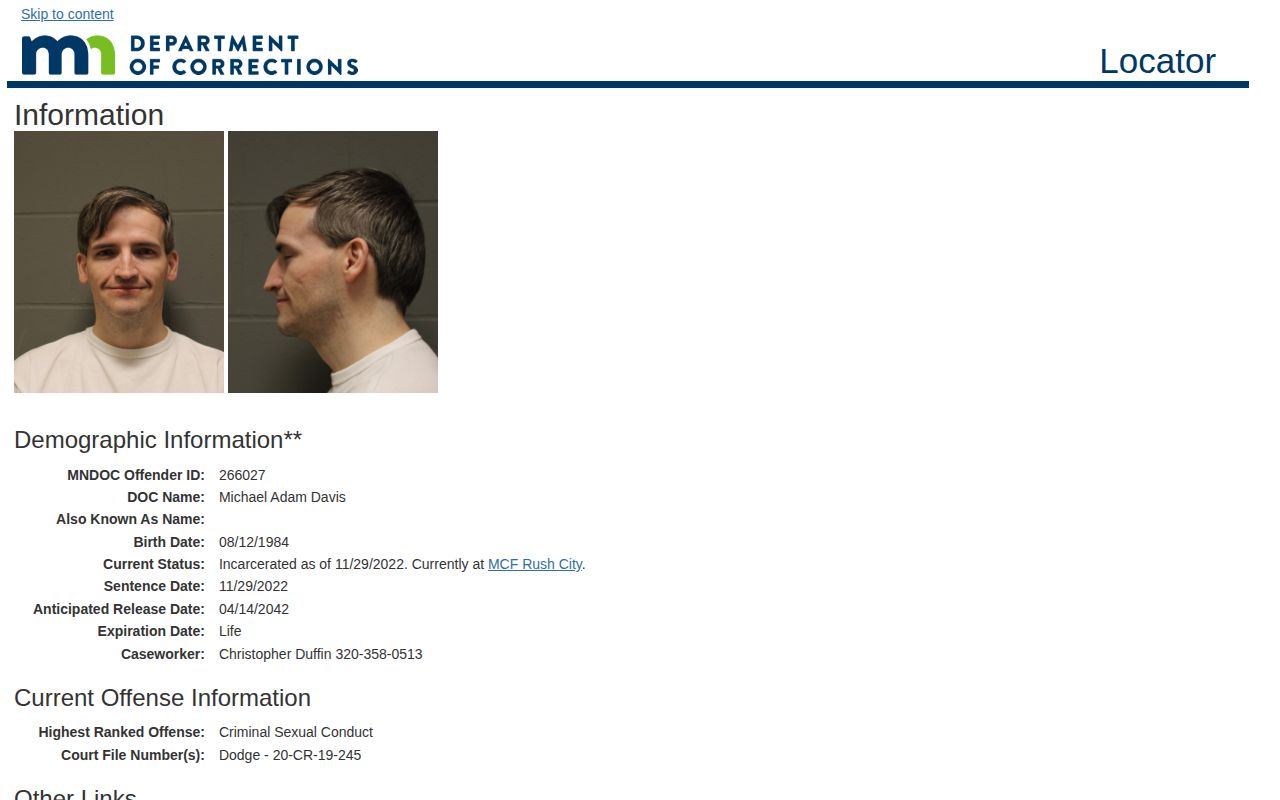
The state display is useful for field recognition, but the example person's facts should not be republished or treated as a Lyon booking record.
Unofficial Lyon County Mugshot Copies
Outside publishers may retain copied booking images long after the Lyon County roster changes. Those sites are not authoritative and receive no links here. Their copy may omit the agency, booking date, disposition, or later correction. Continued display does not prove current custody or establish the outcome of a charge.
A local news report or an official sheriff social post may include an image for a newsworthy case. Research did not find evidence that Lyon County uses social media as a routine release or mugshot feed. A news image therefore supplies story context, not the complete official booking or release record. Match it to the sheriff file or court case before treating it as the same episode.
No official sheriff mobile jail app was found. There is no supported basis for directing readers to an app store or claiming that an app preserves photos after roster removal. The official Facebook link may carry public notices, but no release schedule or photo archive is documented there.
Lyon County Mugshots After Expungement
Expungement seals qualifying records from public view. It does not mean every government record was destroyed, and release from jail does not itself trigger immediate sealing. Minnesota's automatic-expungement law measures some waiting periods from discharge of sentence. Probation or supervised release may continue after the jail door event, so discharge can occur later.
When an official image is no longer available, do not infer that no booking occurred or state why access changed without confirmation. The agency that holds the image determines access under the current classification and any valid sealing order. A person seeking court relief can use the Minnesota Judicial Branch expungement information. That process is distinct from asking an independent publisher about its own copy.
Automatic-expungement categories can include filed cases in which all charges were dismissed, subject to the statutory exception, specified diversion outcomes, cases resolved in the person's favor, and qualifying convictions after the required conditions. For conviction categories, the research identifies waiting periods measured from discharge of sentence: two years for a petty misdemeanor, two for a misdemeanor, three for a gross misdemeanor, four for a felony under § 152.025, and five for another qualifying felony. Not every felony qualifies. New offenses and statutory disqualifiers can also affect eligibility.
The BCA makes an initial automatic-eligibility determination under the state process, but a sealed court or BCA entry does not tell an observer what happened to every copy elsewhere. An image held by Lyon County, a state corrections photo, and a copy once published in a news report can have different custodians and access rules. Each source must be addressed on its own terms.
MCRO can show the case disposition and remotely available orders before access changes, but it is not the source of the jail booking image. Remote person-name criminal searches also exclude pending cases unless a conviction has been entered. When a court file is needed to understand the episode, use a known case number and read the actual order rather than inferring an outcome from a name-search miss.
No enacted current Minnesota law banning commercial pay-to-remove practices or guaranteeing mugshot removal was found in the research sweep. A past proposal is not law. No publisher duty, fee ban, or removal promise should be inferred.
Note: The most reliable correction request goes to the office that created or now controls the specific image record.